
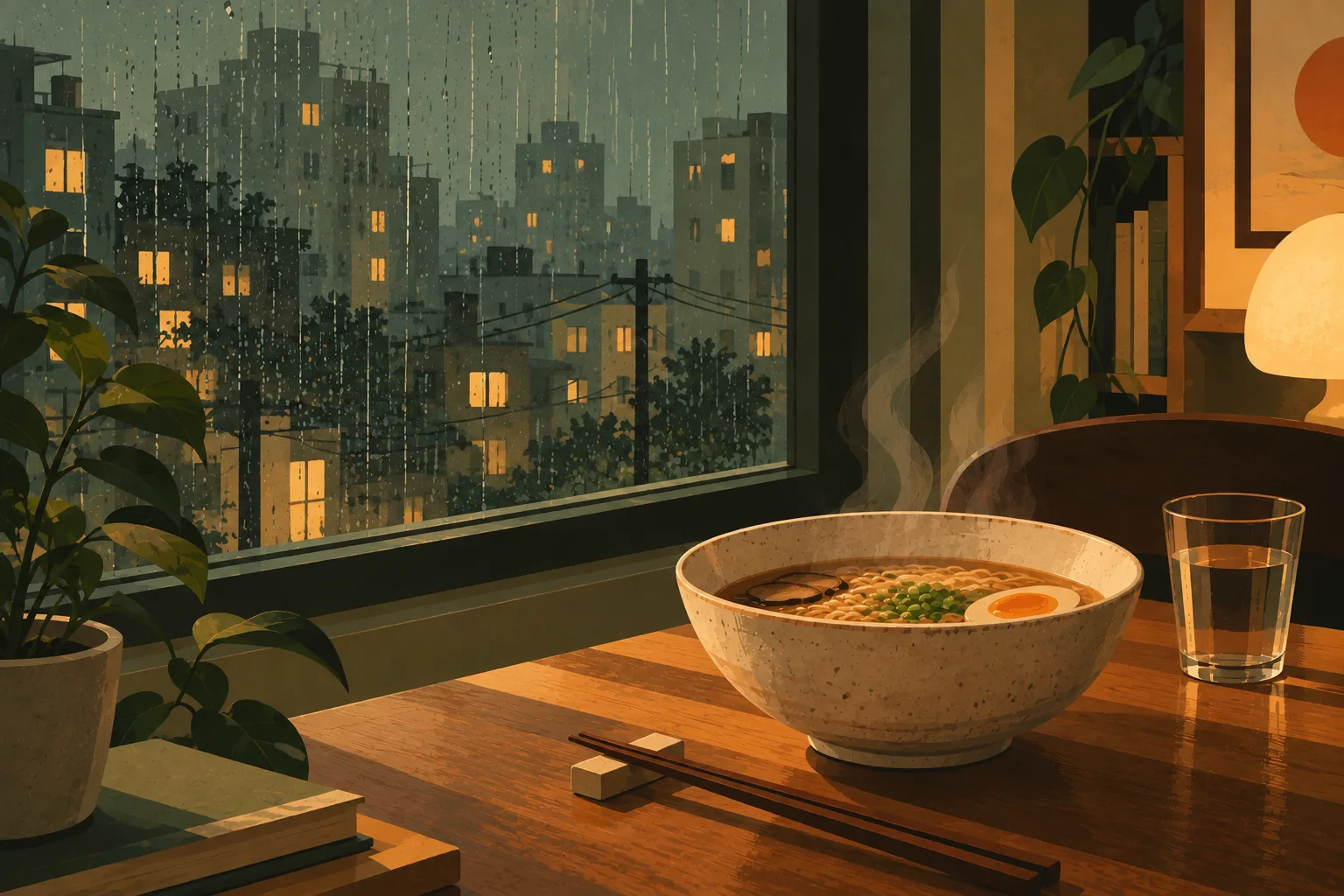
There are days when the rain changes the plan.
The sky darkens earlier than expected. The sound of rain settles against the windows. Going outside suddenly feels like far more effort than it did an hour ago.
And somewhere between afternoon and evening, the question arrives:
What are we going to eat?
Something warm, certainly.
Something with a broth. Something comforting enough to match the weather.
Ramen sounds perfect.
There is only one problem - nobody particularly wants to go out for ingredients.
Then you remember the dried mushrooms.
Sometimes the best ingredients are the ones already waiting
There is something deeply satisfying about discovering that the beginning of a good meal is already at home.
A handful of dried shiitake goes into a bowl of water.
And then, for a while, nothing needs to happen.
The mushrooms slowly absorb the water. Their folded caps begin to soften. They become fuller and heavier. What looked small and dry only a short while ago gradually starts looking like dinner.
Meanwhile, there is time to see what else is around.
Noodles.
Garlic.
Ginger.
An egg, perhaps.
Some spring onion or chilli.
Soy sauce.
Nothing particularly extravagant. Just a collection of ordinary ingredients waiting for something to bring them together.
That something is mushroom.
The broth is where it begins
A good mushroom broth does not need to announce itself loudly.
It builds.
Garlic and ginger hit the warm pan. The rehydrated shiitake is sliced. Water or stock goes in, followed by soy sauce and whatever else the kitchen happens to offer.
And then there is the mushroom soaking liquid.
Dried shiitake can release considerable flavour as it rehydrates. When suitable for the recipe, that liquid can be carefully strained to remove any sediment and added to the broth.
Suddenly, water that might otherwise have gone down the sink becomes part of dinner.
The broth darkens slightly.
The aroma changes.
Something that started with a few dried mushrooms begins to taste as though it has been cooking for much longer than it actually has.
This is one of the small pleasures of cooking with dried mushrooms - sometimes the process of bringing the ingredient back also gives you something extra to cook with.
Then comes the bowl
The noodles need only a few minutes.
They slip into the broth and begin to soften. The mushrooms go back in. Perhaps there is a soft-boiled egg on top, a little spring onion, chilli oil or sesame.
Maybe it is not technically the ramen someone in Tokyo would make.
That is perfectly fine.
This is not about recreating a restaurant dish with absolute precision.
It is about the particular pleasure of making something deeply satisfying from what was already available.
A bowl is filled.
Steam rises.
Outside, it is still raining.
Inside, dinner suddenly feels considerably more interesting.
Why mushrooms work so well in food like this
There is a reason mushrooms feel at home in soups, broths and noodle dishes.
They are naturally rich in compounds associated with umami - the savoury taste often described as the fifth basic taste alongside sweet, sour, salty and bitter.
Some mushrooms contain naturally occurring glutamate and other flavour compounds that contribute to that deep savoury character. Drying can further alter the flavour and aroma of certain mushrooms, which is one reason dried varieties such as shiitake have played such an important role in East Asian cooking.
In a broth, those characteristics have somewhere to go.
The mushroom does not simply sit among the other ingredients. Its flavour becomes part of the liquid surrounding everything else.
Every spoonful carries some of it.
Perhaps that is why mushroom soup feels so naturally comforting. It can be light without tasting empty, simple without being bland.
It doesn't have to be ramen
The same idea can go in many directions.
A handful of rehydrated mushrooms can become part of a clear soup with ginger and spring onion.
They can go into a thicker chicken broth.
They can join vegetables, chilli and noodles in something inspired by Chinese or Korean cooking.
Or the noodles can disappear altogether.
Add chicken, vegetables, lentils, rice or whatever makes sense with the ingredients already at home.
The point is not the exact recipe.
The point is having an ingredient that leaves room for improvisation.
There is a particular freedom in food that can wait
Fresh ingredients have their own pleasure.
A beautiful box of fresh mushrooms almost demands that something be cooked with them soon.
Dried mushrooms behave differently.
They wait.
Not indefinitely, of course - they still need to be stored properly and used within their stated shelf life. But there is no immediate question of what needs to be cooked tonight before it loses its best condition.
That changes the relationship slightly.
The mushroom does not decide when dinner happens.
You do.
Weeks after buying it, a rainy evening can suddenly become exactly the right moment to open the packet.
Take what you need.
Seal the rest.
Another meal can happen another day.
Small rituals make good food better
Perhaps part of the appeal is that dried mushrooms ask for just a little patience.
There is no instant transformation.
They go into water looking small and wrinkled. Then they sit.
Gradually, they change.
By the time they are ready, the kitchen has changed too. Ingredients have appeared on the counter. A pot is warming. The rain is still falling outside.
Cooking often works this way.
The meals we remember are not necessarily the most complicated ones. Sometimes they are simply the meals that arrive at exactly the right moment.
A hot bowl held between both hands.
The smell of mushroom, ginger and broth.
Rain against the window.
And the quiet satisfaction of knowing that nobody had to go anywhere to make it happen.
More than something kept for later
Preserving food is often discussed in practical terms.
Shelf life. Storage. Convenience. Less urgency.
All of those things matter.
But there is another side to preservation that numbers do not quite capture.
It allows an ingredient to wait for the moment when you will appreciate it most.
That is what makes having dried mushrooms around feel different.
They might sit unnoticed for days or weeks.
Then comes the evening when the weather turns, plans change and something warm suddenly sounds perfect.
A bowl of water.
A handful of mushrooms.
A little time.
And before long, the rain outside feels less like an inconvenience and more like part of the evening.
Some ingredients are bought for tonight. Others are worth keeping for the night you didn't plan.