
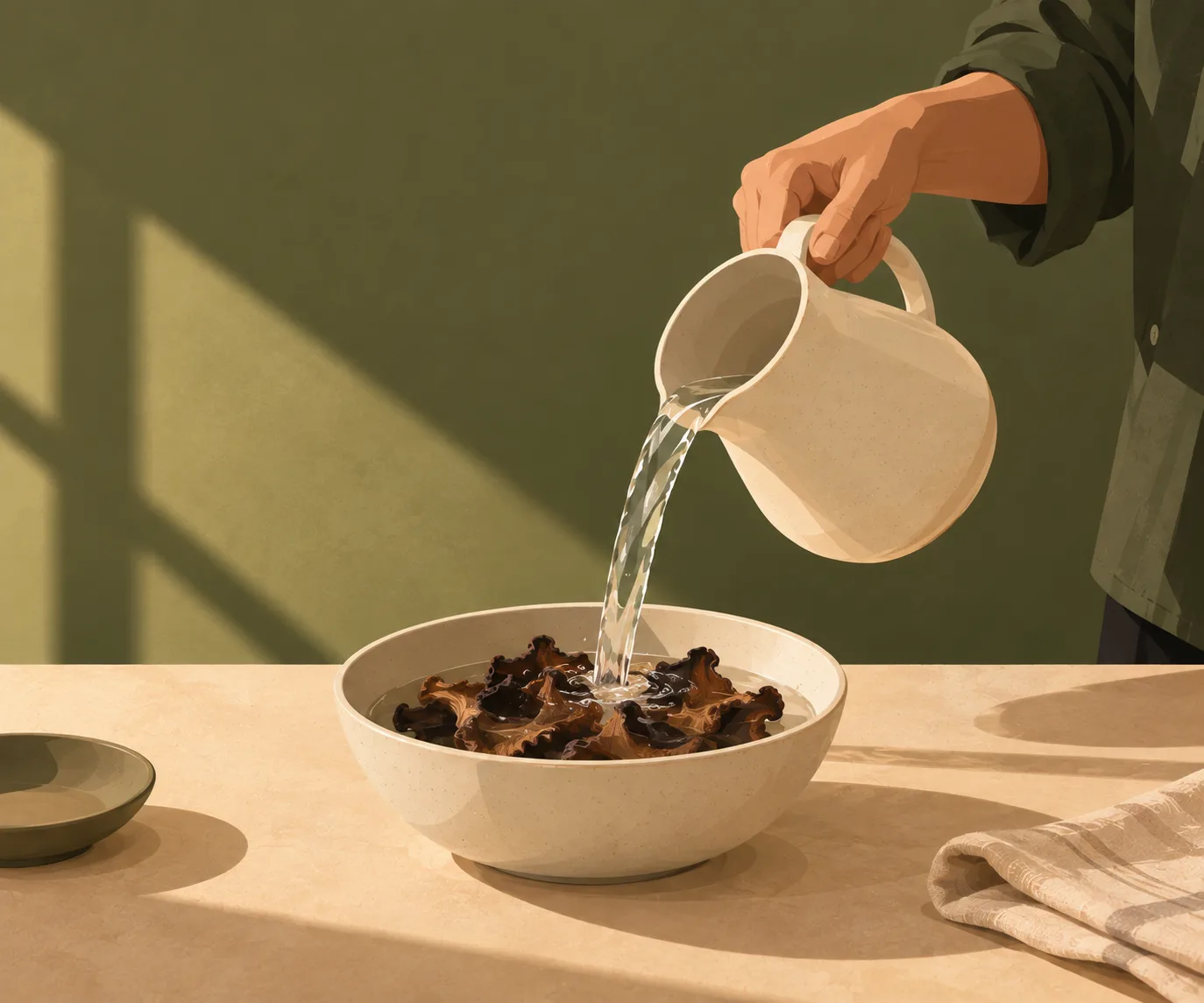
A dried mushroom can look deceptively modest. Light, compact and sometimes a little wrinkled, it bears little resemblance to the mushroom it once was.
Add water, however, and something remarkable happens.
The mushroom slowly unfolds. Its texture softens, its shape returns and aromas that seemed dormant begin to emerge again. This simple transformation is called rehydration, and learning to do it properly can make the difference between a mushroom that is merely edible and one that is genuinely delicious.
At Just Mushrooms, we think rehydration is worth understanding - not because it is complicated, but because a little patience makes a surprisingly big difference.
Why do dried mushrooms need time?
Fresh mushrooms naturally contain a great deal of water. During drying, much of that moisture is removed, making the mushrooms lighter, more compact and easier to preserve.
Rehydration reverses part of that process.
When dried mushrooms are submerged in water, their tissues gradually absorb moisture again. Given enough time, mushrooms that initially feel firm and brittle become flexible, plump and ready to cook.
Trying to rush this process can leave thicker pieces soft on the outside but unpleasantly tough in the centre. Think of soaking as part of the cooking process rather than an inconvenient step before it.
The simple method
For most dried mushrooms, you don't need any specialist equipment.
Place the mushrooms in a clean bowl and cover them generously with water. Because dried mushrooms can float, make sure they remain in contact with the water - a small plate placed gently on top can help.
Soak for at least 1 hour, or until properly softened.
When you have more time, a 3-4 hour soak can give many varieties a fuller, softer texture, particularly thicker mushrooms.
Once rehydrated, rinse them with clean water and allow excess water to drain. They are now ready to be sliced, seasoned and cooked.
The important thing is not simply watching the clock. Feel the mushroom. A properly rehydrated mushroom should no longer have a hard, dry centre.
Should you use hot or cold water?
There isn't one perfect soaking temperature for every mushroom or every recipe.
Cool or room-temperature water offers a gentle, reliable approach and works particularly well when you have time. Warmer water can speed things up, but very hot water isn't automatically better.
Our preference for everyday cooking is simple: give the mushrooms time rather than excessive heat.
If you're preparing dinner later, put them to soak earlier. Rehydration becomes almost effortless.
Different mushrooms behave differently
This is where things become interesting.
A dried shiitake is not the same as a dried wood ear, just as neither behaves quite like lion's mane, enoki or button mushroom.
Shiitake becomes satisfyingly tender while retaining a substantial bite. Its characteristic savoury aroma makes it particularly suited to broths, noodles, rice dishes and slow-cooked recipes.
Wood ear behaves differently. Rehydration restores its distinctive springy, crunchy texture - the very quality prized in many Chinese and East Asian dishes. It should not necessarily become soft in the way you might expect from a button mushroom.
Lion's mane has its own remarkable structure. Once hydrated and cooked correctly, its fibrous texture can pull apart into substantial pieces, which is why cooks around the world experiment with it in everything from curries to mushroom "crab" cakes.
Understanding these differences is part of learning to cook with mushrooms rather than treating every variety as interchangeable.
Don't overlook the soaking water
With aromatic varieties such as dried shiitake, the soaking liquid can develop considerable mushroom flavour.
Depending on the mushroom and the recipe, that liquid can sometimes become part of the dish itself - adding depth to a soup, ramen broth, sauce or rice dish.
If you intend to use it, allow any sediment to settle and strain the liquid carefully through a fine strainer or suitable filter before cooking.
However, soaking liquid shouldn't automatically be used in every recipe or from every mushroom variety. When in doubt, discard it and use fresh water or stock.
Rehydration is only the beginning
Rehydrating a mushroom does not mean it is ready to eat.
Think of the hydrated mushroom as an ingredient that has been restored to a state where you can cook with it. After soaking and rinsing, cook it thoroughly using the method appropriate for your dish.
It might be simmered gently in a curry, tossed into a wok, folded through rice, added to soup or allowed to absorb the flavours of a slowly developing broth.
And this is perhaps where dried mushrooms become most interesting: rehydration gives you the ingredient back; cooking gives it character.
A few mistakes worth avoiding
Don't use too little water - the mushrooms need room to expand.
Don't assume every variety should have the same final texture.
Don't stop soaking simply because the outside has softened; check thicker sections for a dry centre.
Don't confuse rehydrating with cooking.
And before using any dried mushroom, inspect it. If its appearance or smell seems unusual, or there are signs of spoilage, don't use it.
The value of slowing down
Modern cooking often celebrates speed. Ten-minute dinners. Instant sauces. Ingredients designed to go straight from packet to pan.
Dried mushrooms ask for something slightly different.
They ask you to plan ahead.
Put them in water. Leave them alone. Come back later.
What initially looks like an extra step becomes part of the pleasure of cooking with them - the transformation from something small and preserved into an ingredient full of texture, aroma and possibility.
Once you understand that process, a packet of dried mushrooms stops feeling like a substitute for fresh mushrooms.
It becomes something worth keeping in the kitchen in its own right.
Because sometimes, the best way to bring an ingredient back to life is simply to give it time.