
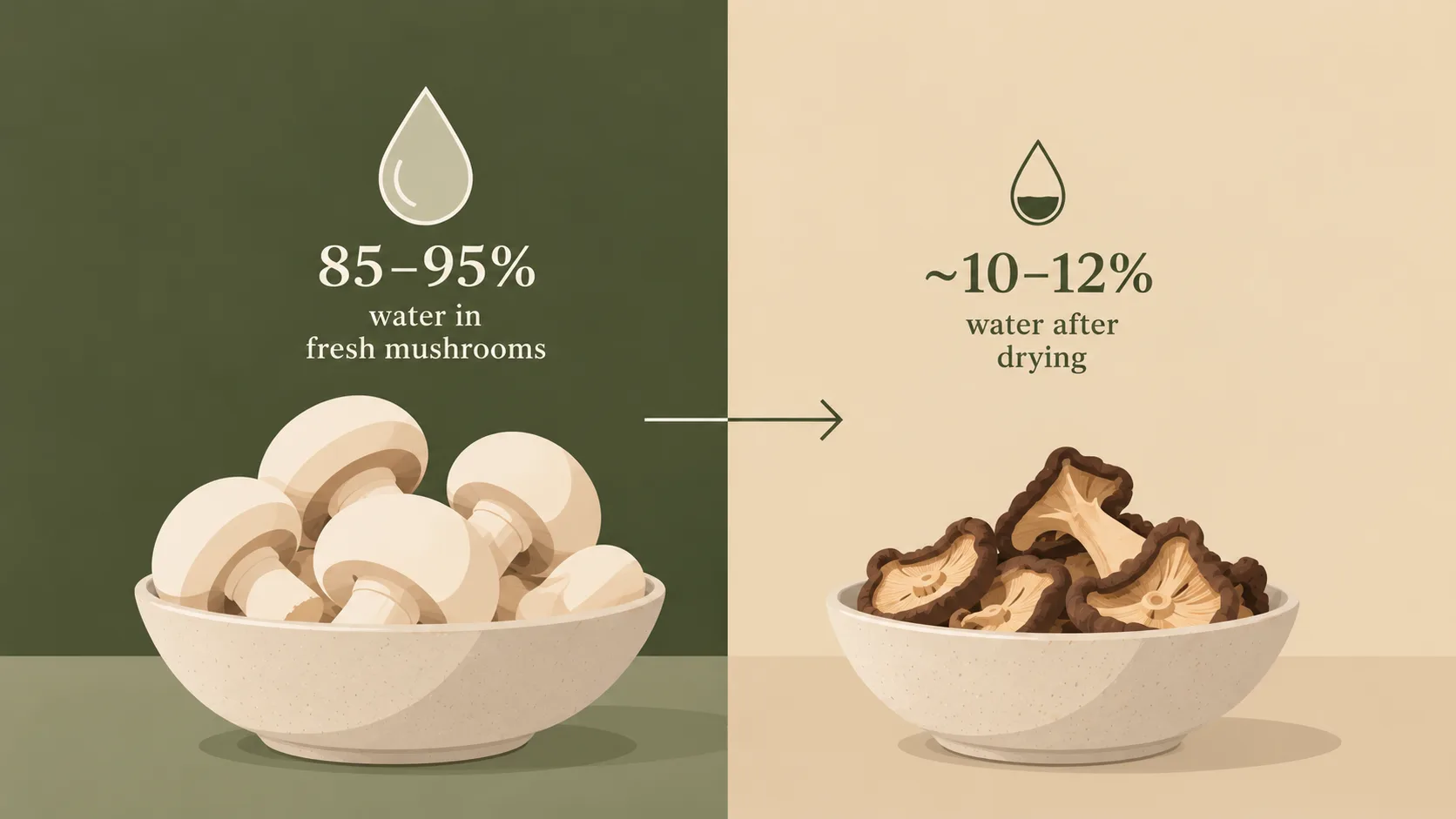
Pick up 100 grams of fresh mushrooms and most of what you are holding is something surprisingly ordinary: water.
Fresh mushrooms typically contain around 85-95% water. It is one of the reasons they feel tender and substantial when fresh - and one of the reasons they can deteriorate so quickly after harvest.
Remove most of that water and something interesting happens.
The mushrooms become dramatically lighter and smaller. Their appearance changes. Their texture changes. In some varieties, their flavour changes too.
Most importantly, an ingredient that was highly perishable becomes much easier to preserve.
That is what makes dried mushrooms more than simply fresh mushrooms without the water.
Why are fresh mushrooms so perishable?
Mushrooms are delicate after harvest.
Unlike many fruits and vegetables, they do not have a protective cuticle layer that effectively shields them from water loss, physical damage and microbial attack. Their high moisture content and high respiration rate also contribute to rapid deterioration.
Research reviews describe fresh mushrooms as one of the more perishable food products. Depending on the variety and conditions, quality can deteriorate within just a few days at room temperature. Refrigeration extends that window, but fresh mushrooms still remain a product that needs careful handling and relatively quick consumption.
You have probably seen the process yourself.
A fresh mushroom that looked perfect when purchased can gradually lose firmness, change colour and develop a less appealing texture if forgotten for too long.
Drying tackles one of the fundamental factors behind that short life: water.
What actually happens when a mushroom is dried?
Drying sounds simple - remove water from food.
Scientifically, however, that change is important.
Microorganisms and many of the reactions responsible for food deterioration depend on the availability of water. By reducing moisture and, importantly, water activity, drying creates conditions that are much less favourable for microbial growth and slows many deterioration processes.
This is why drying has been used as a method of food preservation for thousands of years.
Mushrooms are particularly suited to the idea because they begin with so much water.
One scientific review notes that mushrooms can contain around 90% moisture when harvested and discusses drying them down to roughly 10-12% moisture for longer-term preservation.
Think about what that means physically.
A large amount of the weight and volume of a fresh mushroom is temporary. Remove the water and what remains is a much smaller, concentrated version of the ingredient.
That tiny-looking packet suddenly makes a lot more sense.
100g dried and 100g fresh are completely different things
This is one of the easiest things to misunderstand about dried mushrooms.
If most of a fresh mushroom's weight is water, comparing fresh and dried mushrooms gram for gram is not a meaningful comparison.
Drying removes much of that water.
So 100 grams of dried mushrooms represents substantially more original mushroom material than 100 grams of fresh mushrooms. The exact fresh-to-dried ratio varies considerably by species, drying method and final moisture level, so there is no single conversion figure that applies to every mushroom.
But the principle is simple:
dried mushrooms are concentrated by the removal of water.
When you later soak them, they absorb water again, expand and regain a texture suitable for cooking.
This is why a relatively small amount of dried mushroom can go much further in a dish than its appearance in the packet might suggest.
Drying doesn't simply freeze a mushroom in time
There is an important distinction here.
Drying preserves mushrooms, but it does not leave them chemically and physically identical to fresh mushrooms.
Different drying methods - including hot-air drying, freeze-drying, microwave drying and other technologies - affect colour, structure, aroma, nutrients and other compounds differently.
Research comparing mushroom-drying techniques continues precisely because there are trade-offs. Some methods may preserve particular characteristics better than others, while excessive heat can degrade certain nutritional or flavour compounds.
So it would be misleading to say that a dried mushroom is simply a fresh mushroom perfectly preserved in miniature.
It has been transformed.
And sometimes that transformation is part of the appeal.
Some flavours become different too
Shiitake is a wonderful example.
Anyone who has cooked with both fresh and dried shiitake knows they are not quite the same ingredient.
Drying and subsequent rehydration can change the mushroom's aromatic and savoury characteristics. Research into dehydrated edible mushrooms has found that drying influences flavour formation through changes involving amino acids and other compounds.
This helps explain why dried mushrooms have such an established place in cuisines where fresh mushrooms are also readily available.
People are not necessarily choosing dried because fresh is unavailable.
Sometimes dried is simply what the dish calls for.
A deeply flavoured broth made with dried shiitake is a good example. The mushroom itself becomes part of the meal, while its soaking liquid can contribute another layer of mushroom flavour to the broth.
Preservation, in this case, has also created a different culinary ingredient.
More time changes how we use food
There is another advantage that is less scientific but equally important.
Fresh food creates urgency.
You buy it, store it correctly and try to use it while it is still at its best.
Drying gives you more time.
Properly packaged dried mushrooms can be stored for much longer than fresh mushrooms. Instead of planning a meal around mushrooms that need to be used quickly, you can keep dried mushrooms available and take only the amount required for a particular dish.
Twenty grams today.
Another portion next week.
The remainder stays sealed until you need it.
For households, that is convenient.
For the mushroom industry, the implications are much bigger.
Preservation matters beyond the kitchen
A mushroom's journey does not begin at a supermarket or on a website.
Someone has to grow it.
It has to be harvested at the right time, handled, processed, transported, stored and eventually sold.
When the product at the beginning of that chain is highly perishable, time becomes a serious constraint.
This matters particularly when thinking about how mushroom industries develop.
Drying can extend the useful life of a harvest and reduce its weight and volume, making storage and distribution more practical. It can also allow mushroom varieties to travel further and remain available beyond the immediate period in which they were harvested.
That does not mean drying solves every problem of food loss or mushroom distribution.
But preservation creates options.
For countries such as Bangladesh, where mushroom cultivation and consumer awareness have room to grow, those options matter. A stronger mushroom sector is not only about growing more mushrooms. It also requires thinking about processing, preservation, distribution, product development and ultimately creating reasons for more people to eat them.
Drying is one piece of that much larger system.
Good storage still matters
"Dried" does not mean indestructible.
Moisture can compromise dried food, which is why packaging and storage matter even after dehydration.
Dried mushrooms should be kept sealed in a cool, dry place away from moisture and direct light, following the storage and expiry information supplied with the product.
Before using them, look at them.
If you notice unexpected moisture, visible spoilage, or an unusual smell or appearance, don't use them.
Drying gives food more time.
Proper storage helps protect that advantage.
An old idea with a very modern purpose
There is nothing new about drying food.
Humans were preserving food with air and sunlight long before we understood water activity, microorganisms or food chemistry.
What has changed is our ability to understand and control the process.
Today, researchers study hot-air drying, freeze-drying, vacuum drying, microwave-assisted techniques and other technologies to understand how they affect mushroom quality, nutrition, structure and flavour.
The principle underneath all that technology, however, remains wonderfully simple.
Take something that contains a remarkable amount of water.
Remove enough of that water carefully.
Protect what remains.
Then, when the time comes to cook, add water back.
A fresh mushroom may have only a short window in which to be enjoyed. Drying gives that mushroom a different kind of life - lighter, smaller, easier to keep and ready to become part of a meal much later.
Sometimes preserving food is not simply about making it last longer. It is about giving it more opportunities to be used.